Obzerv
Keep your services up. Keep your team sane.
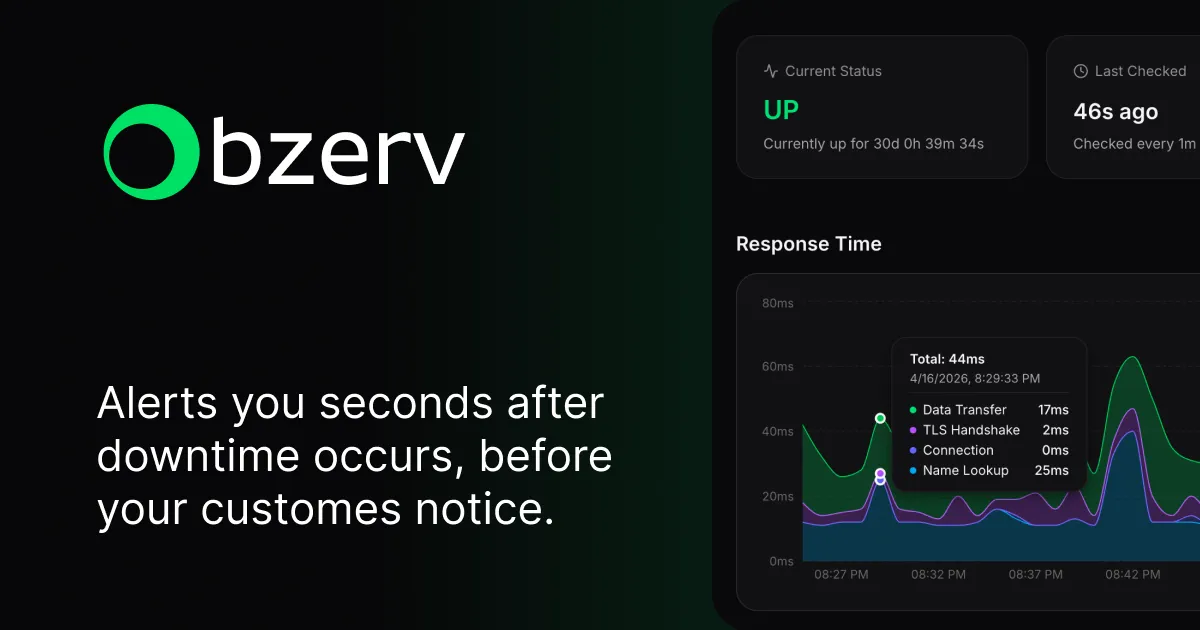
Monitoring that has to be right at three in the morning. Checks run from several regions on a schedule, alerts arrive the moment a probe disagrees, and the status page is public enough that nobody has to ask. We run our own eight on it, which is why it is built the way it is.
- Runs on
- Web · API
- 15+
- global edge regions
- 30s
- check intervals
- 99.99%
- uptime SLA
- < 30s
- median alert delivery
- The hard part
- The failures that matter least are the ones you cause yourself. Last May a run of monitors went red together, twenty-four failures across twenty unrelated targets inside two hours, and none of those targets had gone anywhere. Our own resolver had buckled under load. From inside the process, a resolver timeout and a dead server produce the same error. The fix was to stop pretending we knew. Obzerv now tells a real NXDOMAIN apart from an unreachable resolver, and when the answer is genuinely unknown it writes nothing at all. The status page shows a gap, because a gap is what happened.
- A call we made
- We wanted two things at once. Only alert when several regions agree a target is down, and never go quiet because a region died. Those pull against each other: a strict quorum silences you at exactly the moment half your evidence has disappeared. So the quorum follows the number of regions actually alive. Both up and they have to agree. One down and the survivor pages on its own. Every failure path keeps the previous verdict instead of guessing, which makes us silent about change and never wrong about state.
- What it taught us
- A schema tells you what a field is allowed to hold. Production tells you what it actually holds, and the two drift apart quietly over months. The failures worth preparing for are rarely in the code. They are in rows written long before that code existed, by an older version of your own assumptions. Every change to the fleet is now rehearsed against a copy of the live data first.
What it does
Everything below is live today on obzerv.xyz — not a roadmap.
Website and API checks
HTTP, status codes and response bodies — not just a ping that says the box is on.
Multi-region probes
A failure in one region is a routing problem; a failure in all of them is your problem.
Alerts in under a minute
Median delivery under thirty seconds, routed by severity to the channel the on-call actually watches.
Status pages
A public page you can point customers at, with the history already on it.
SSL expiry warnings
Advance notice thirty, fourteen and seven days out, delivered to the same channel as everything else — so a certificate never lapses quietly.
Wherever the team already is
Email, Slack, Discord, Telegram, Microsoft Teams, SMS and webhooks, with routing rules per severity.
Uptime and API monitoring for anyone who ships.
Everything about Obzerv — the interface, the servers, the support inbox — is ours. The fastest way to judge it is to use it.