AppEcho
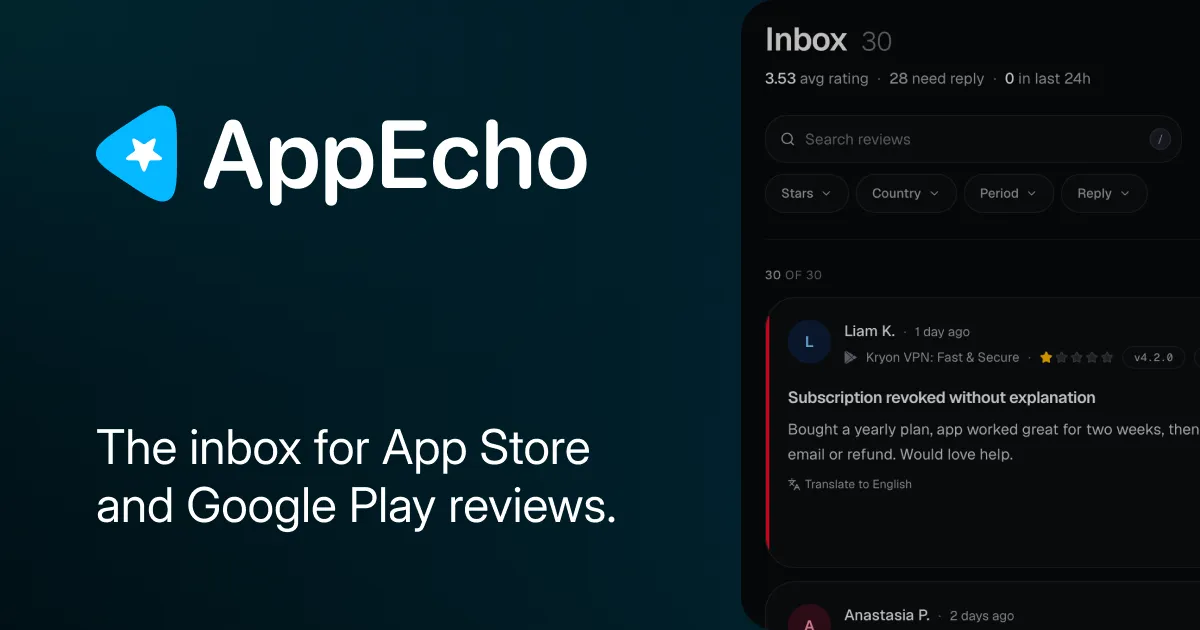
The inbox for App Store and Google Play reviews.
Two stores, two consoles, two backlogs — and the useful sentence is always buried on page four. AppEcho pulls both feeds into one inbox, drafts the reply, translates the review, and tells you which release started the complaints.
- Runs on
- App Store · Google Play
- 60+
- languages
- 29
- theme labels
- 2
- stores, one inbox
- 3
- reply tones
- The hard part
- The two stores do not agree on what a review is. Apple hands them back per storefront and caps how deep you can go. Google returns only the slice matching one language and one country, and attaches no country to the result at all. A complete inbox means fanning out across a hundred and fifty-nine Apple storefronts and twenty-five Google market pairs, stamping in the country Google will not tell you, and staying under the point where either store starts refusing. Then all of it has to land in the database without a thousand round trips per pull.
- A call we made
- Google publishes an official reviews API and we do not use it for reading. It returns the last seven days. That is fine for a notification and useless for a product whose whole promise is that nothing gets lost. Scraping costs us a concurrency ceiling, the risk of being throttled, and no service guarantee to point at if it breaks. We took all three instead of shipping an inbox with a seven-day memory.
- What it taught us
- A free tier is a hypothesis, and the only measurement that settles it is where people stop. We watched, and they stopped mid-task: someone working through a genuine backlog on a single app, reaching the ceiling before the job was done. The ceiling now sits where the work ends rather than where the spreadsheet did. A free tier that runs out during the first honest use has not been tried, it has been abandoned.
What it does
Everything below is live today on appecho.xyz — not a roadmap.
AI reply drafts
Three tones per review. You pick, edit and send — the blank page is gone.
Translation
Sixty-plus languages, cached, so the same review never costs twice.
Themes and sentiment
Twenty-nine canonical labels applied automatically, so patterns surface on their own.
Voice of the customer
An executive summary on demand, with the verbatim quotes that matter — not a chart with no words in it.
Reply templates
Saved answers with usage tracking, so the team says the same thing twice on purpose.
Problem versions
The releases with the worst average rating, with the share of one- and two-star reviews beside each.
Reviews become a queue of decisions, not a wall of noise.
Everything about AppEcho — the interface, the servers, the support inbox — is ours. The fastest way to judge it is to use it.